Amazon ACOS vs TACOS explained: the formulas, a worked example, 2026 benchmarks by category and product stage, and proven tips to lower both PPC metrics.
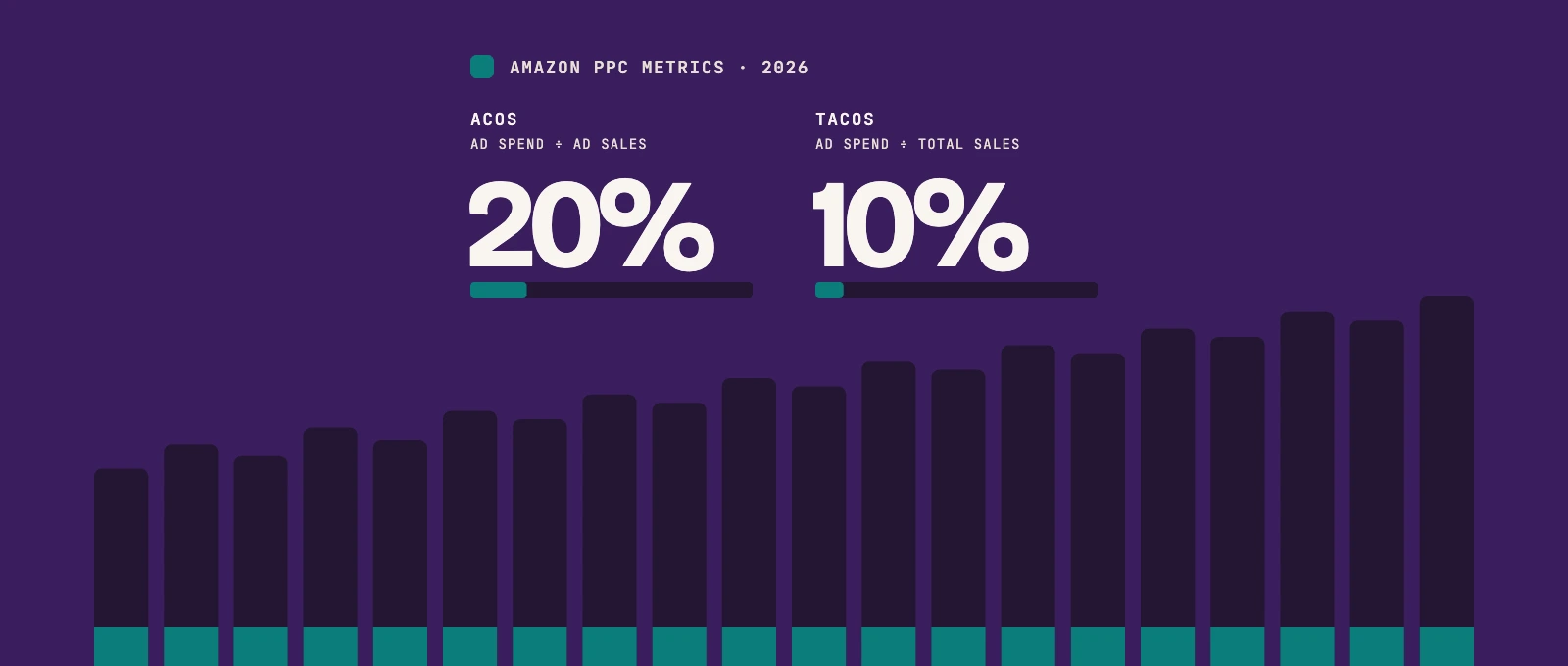
ACOS vs TACOS on Amazon: How to Measure Advertising Performance in 2026
Overview
If you are running ads on Amazon you’d probably come across two metrics: TACOS and ACOS. The two important metrics that determine your ad efficiency and your overall advertising performance.
ACOS measures your ad efficiency based on your ad sales, while TACOS measures your advertising against your total sales, which also includes your organic sales.
The difference between ACOS and TACOS can change how you look at your advertising results. Lower ACOS may show that your ads are generating sales efficiently but it doesn’t tell how those ads are impacting your overall business, whereas TACOS gives you a better perspective about your ad spend. All the data is related to your overall ad revenue in Amazon.
Knowing the difference between ACOS and TACOS and how they impact your business will help you make better strategic decisions in your Amazon PPC performance.
What Are ACOS and TACOS?
ACOS (Advertising Cost of Sales) is the amount of your advertising spend compared with the sales generated from your ads. It is basically used to measure how effective and efficient your campaigns are and how it is converting revenue into your business.
TACOS (total advertising cost of sales) is the overall advertising spent against your total Amazon sales, which includes all the sales which came from ads and also organic sales. It gives you a better perspective of how your ad campaigns are performing and how they are impacting your overall business.
The key difference is in the sales and how each metric is viewed.
While ACOS looks at only the sales that are generated from advertising, TACOS look at your total sales, total revenue in your business.
Because of this Acos is more focused on the ad efficiency while Tacos helps you understand your overall spending and overall sales growth.
Neither of the metrics is more important than the other. If you are into Amazon business, if you are into Amazon ads, and if you are going to evaluate your advertising performance, both ACOS and TACOS hold key value and perform as key indicators in the bigger picture of your Amazon business.
How to Calculate ACOS and TACOS
ACOS Formula
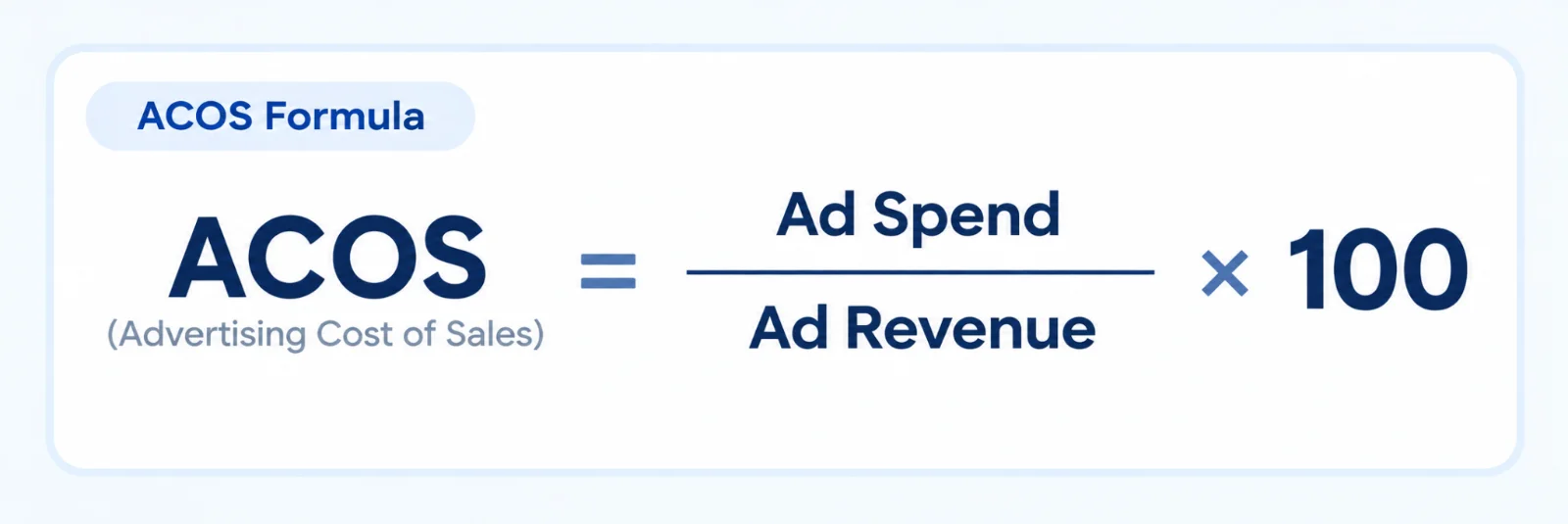
ACOS shows how much you spend on advertising to generate sales attributed to your ads.
TACOS Formula
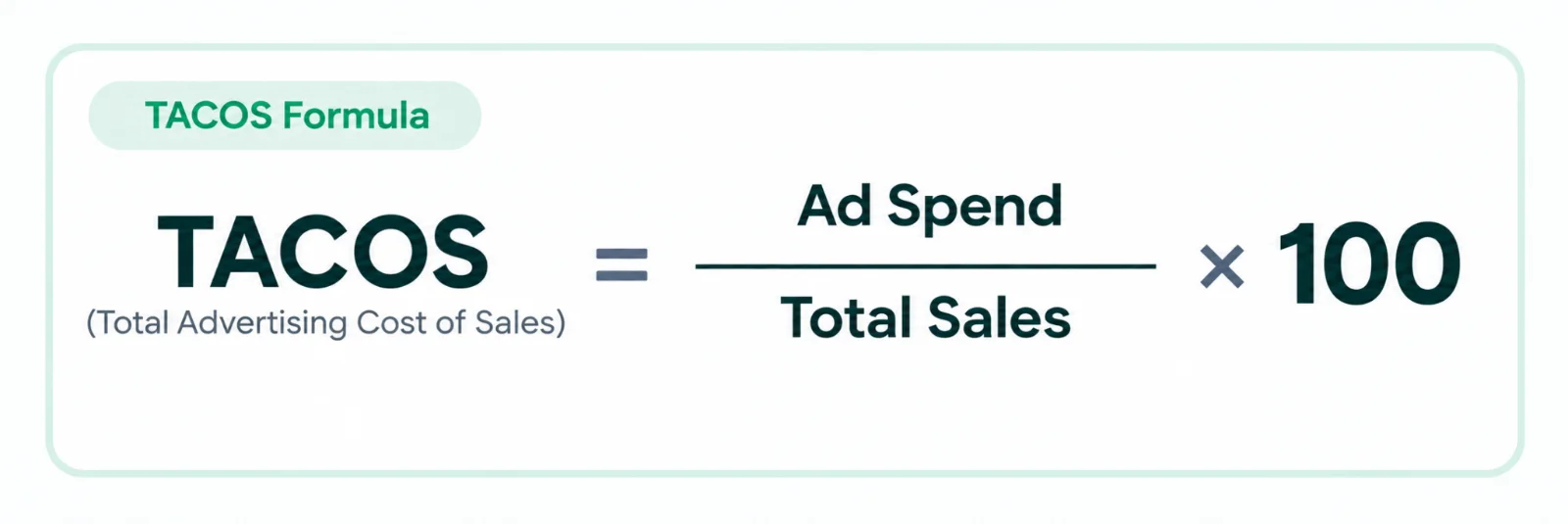
TACOS shows how much of your total Amazon sales goes toward advertising. Unlike ACOS, it includes both ad-attributed and organic sales.
ACOS vs TACOS: A Simple Example
Now, let’s look at both metrics together.
Suppose you spend $500 on advertising, generate $2,500 in ad-attributed sales, and make $5,000 in total sales.
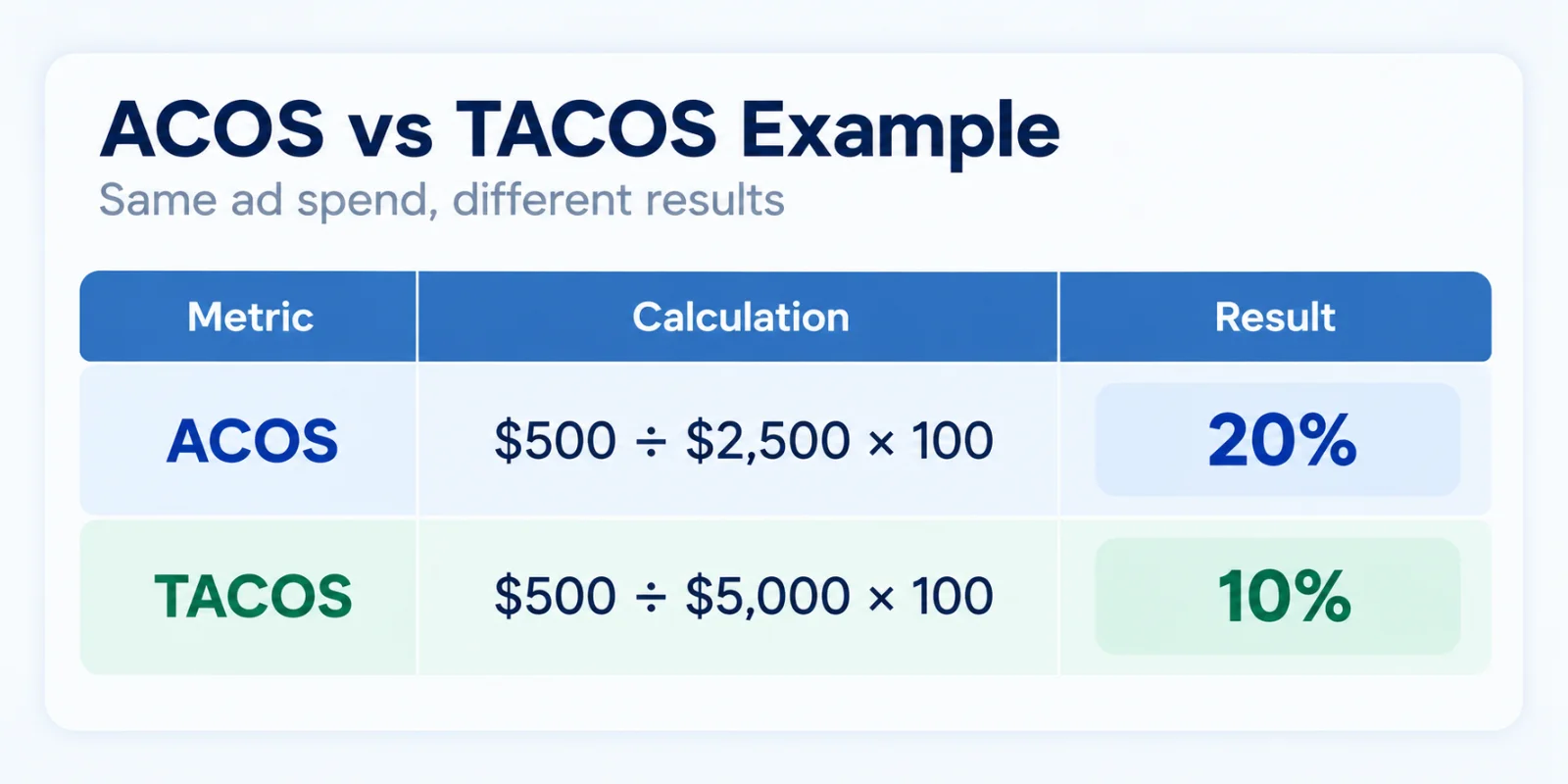
In this image you can see the ACOS is higher because it is only considering the sales that are attributed to the advertising, the sales that are generated from the ads. You can see the TACOS is lower because it considers your overall sales, which include the organic revenue also.
This is why looking at both metrics is important and gives a clear and broader perspective of your Amazon advertising performance.
Understanding What Your ACOS Really Means
ACOS is useful for measuring your ad efficiency but it doesn’t show the complete picture of your overall Amazon business.
A lower ACOS doesn’t always mean your business is performing really well. For example you could have an ACOS of 15% with your total sales but your organic sales might be dropping or declining. By the way, it might look like your ads are efficient, but your overall business performance could still be going down drastically and losing momentum. Your business could be in a decline or a loss.
Similarly a higher ACOS isn’t always a problem. There are a lot of factors that actually impact the higher percentage of ACOS. For example during a growth phase or a product launch, sellers may be spending more on advertising to gain visibility, to generate sales, or to improve organic performance. In that case your scores will be higher but it doesn’t always mean it is bad or negative.
How Organic Sales Change ACOS
As your ACOS only considers the ad-attributed sales so it doesn’t account for the amount of sales your product generates organically.
If your organic sales grow while your advertising spend remains stable or normal, your business may depend less on the advertising part; however your ACOs alone show improvements in your overall sales.
And that is why ACOs should be viewed alongside TACOs. Both metrics play an important role in determining the overall performance of your advertising.
To Learn more about the metric, check out our detailed guide on What Is a Good ACOS on Amazon in 2026? A Complete Guide to Understanding ACOS
How TACOS Helps Measure Overall Amazon Growth
TACOS gives a better and broader perspective of your Amazon business.
Because your total sales involve both the organic sales and advertising sales the sales which are generated from your advertisement
Tacos is the metric that will help you understand how much you are generating revenue from your ads and how much you are generating from the organic sales.
If your total sales grow while your ad spend remains relatively normal and stable, your tacos can be lowered, which may indicate that your business has stronger organic sales and more efficient overall growth.
If your TACOS is rising it means that you are spending more on advertising relative to your total sales. This happens when your ad spend increases faster than your sales or when the percentage of your organic sales declines.
A falling TACOS indicates that your total sales are growing faster than your advertising spend. It also tells you that organic sales are contributing more to your overall revenue than your advertising spend.
With everything being said, tacos should always be considered along with the ACOS. Lower TACOS doesn’t automatically mean it is better if your total sales are also falling. We cannot ignore any of the metrics. Each one of them is very important in determining your PPC performance.
To understand TACOS in more detail and it impacts the business for Amazon sellers, read our guide Amazon TACoS: What it Means and Why it Matters
Why Both the Amazon PPC metrics Matters
ACOS and TACOS have different purposes. Amazon sellers should focus on both rather than choosing one metric over the other.
When Does ACOS Matter More?
ACOS is useful when you want to evaluate or look into the ad spend performances. It can help you analyze the campaign efficiency, your PPC campaign strategies, and how the ad strategies are working and if it needs any sort of adjustment.
If your main focus is, “Are my ads generating enough sales?” then ACOS is the metric you need to look into.
When Does TACOS Matter More?
And TACOS becomes more useful and more important when you look at your overall business performance, which includes your ad spend and also organic sales. It will give you a better idea about your total sales and it will help you understand the relationship between paid and organic sales.
If your question is, “How much do my ads contribute to my overall Amazon sales?” then TACOS is the metric you need to look into.
In short ACOS are used to monitor efficiency and TACOS are used to track the overall picture of your Amazon business. Looking at both alongside each other provides you with the complete view of your Amazon business.
ACOS and TACOS Benchmarks: What Good Looks Like at Different Growth Stages
There is no universal ACOS or TACOS target that works for every Amazon seller and business. A lot of factors actually impact the numbers of TACOS and ACOs.
The average benchmark of each category depends on product margin, categories, competition, and the growth stage of each product.
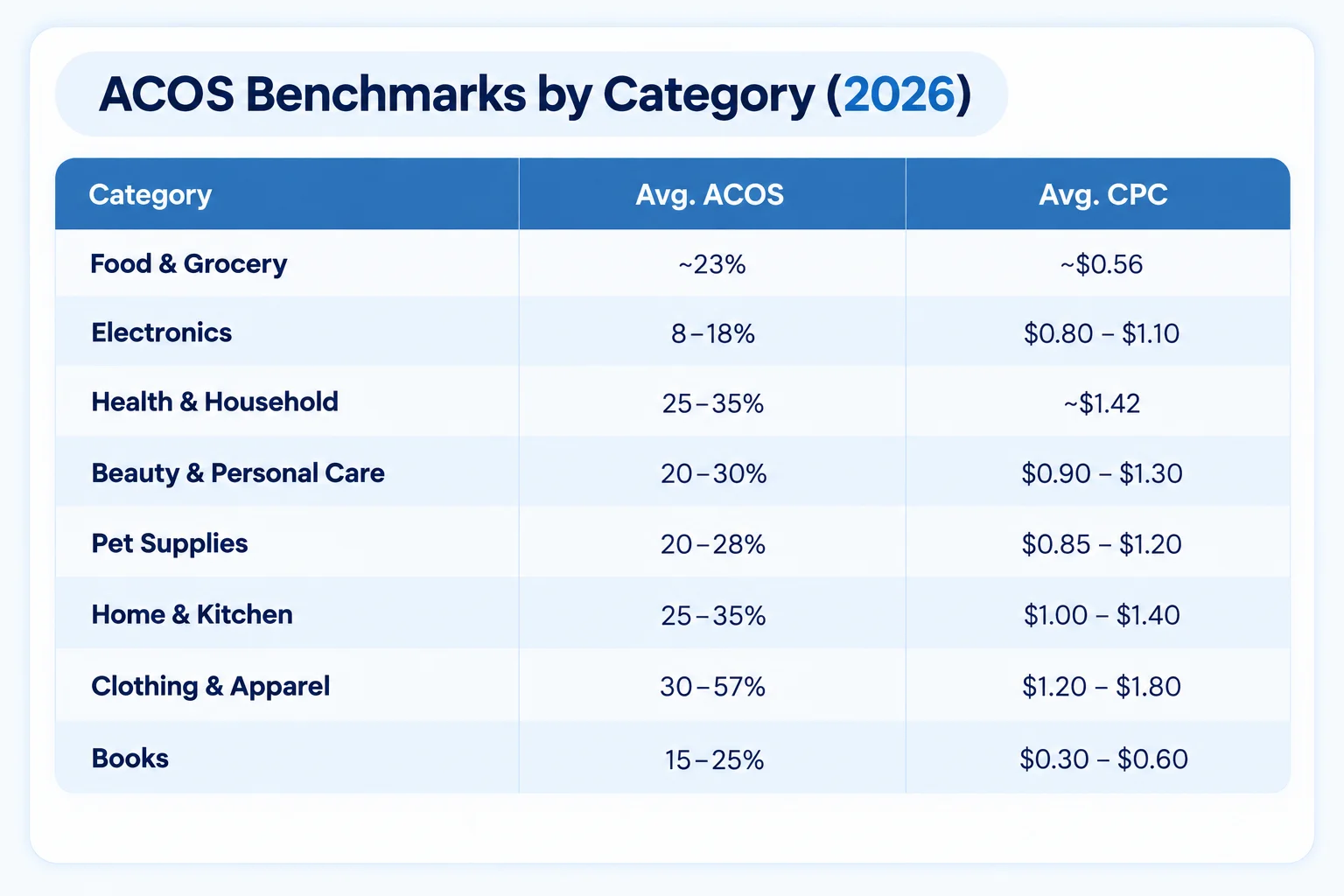
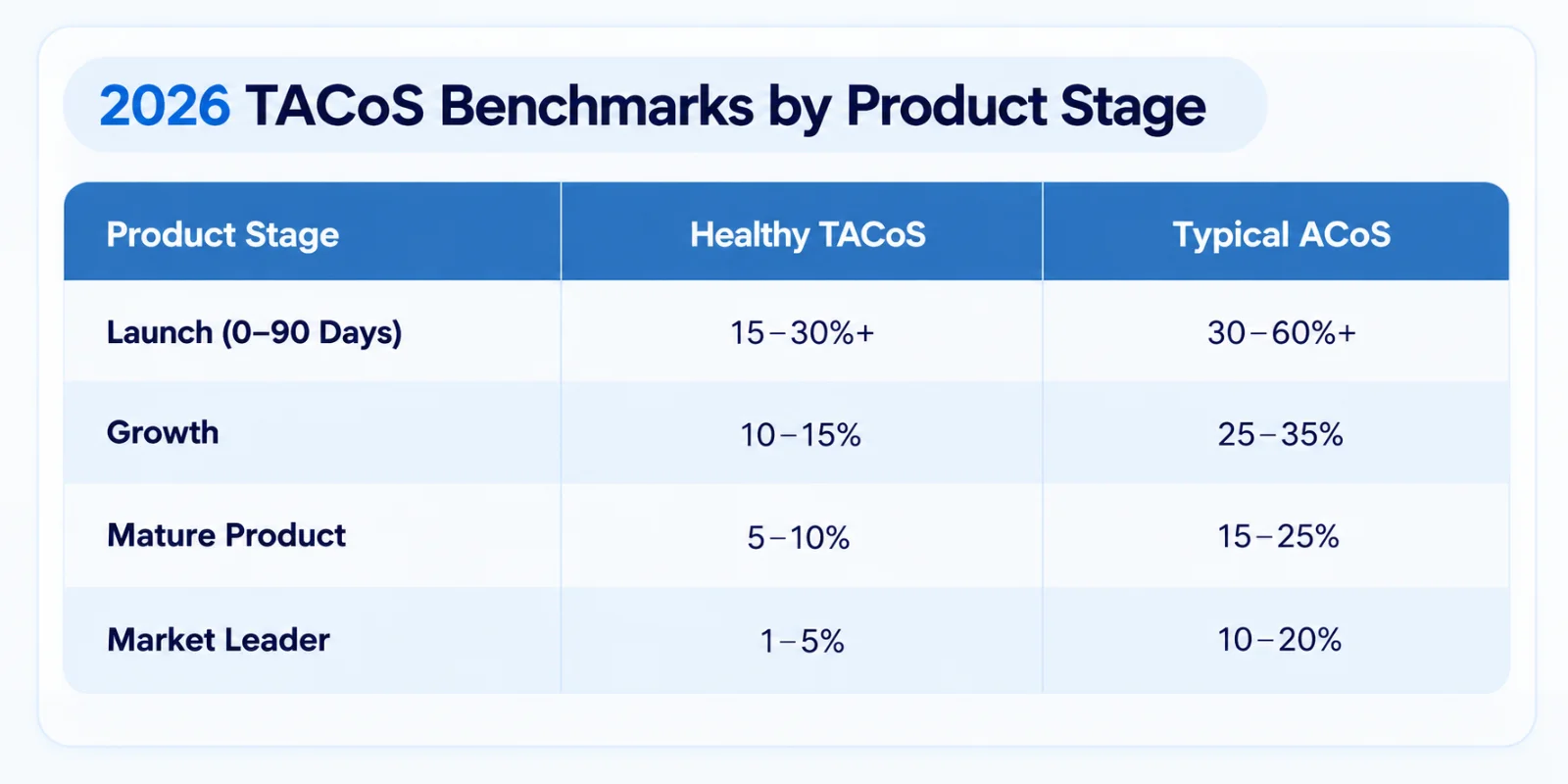
ACOS and TACOS are influenced by various factors and it also tells you why you should not draw a conclusion with a single metric. Let’s look at some of them which impacts both the metrics
New Product Launches
During the launch of a product, higher ACOs can be expected as you’ll be investing more to create visibility and you’ll be spending more to generate sales. In that case ACOs will tend to be at a higher level.
Experienced Products
Also for matured products, which come with consistent organic sales, sellers will focus on maintaining efficiency so they spend more on advertising while supporting the overall growth.
A table or a lower axis alongside will make you understand that organic sales are contributing more than the ad spend to your total revenue.
Sales Events and Promotional Periods
During the event periods such as Prime Day or Black Friday, advertising spend may be increased because the competition will increase and customer demand will create the increase in advertising spend that can lead to a temporary increase in ACOS and TACOS.
So instead of solely judging your campaign performance by looking at tacos, you have to look at the total sales, all the advertising spend, and all the organic sales together to understand whether your investments are working in a better way and supporting your sales and your PPC goal
The right benchmark should never be the lowest tacos. It should align with your profits and gross margins.
Tips to lower ACOS and TACOS with proven strategies
Many sellers focus on reducing the advertising spend to improve ACoS and TACoS but in reality it doesn’t work that way. The opposite approach usually produces better results than trying to reduce your advertising spend.
Few tips with which you can lower your ACOS or TACOS,
Improve listing conversion rate
Before changing anything in your campaign make sure that your listings are top-tier and your product detail page is actually converting and driving results. Having a very good product title, description, strong A+ Content, and clear product benefits can help you get a lot more sales.
Refine keyword targeting
Focus on the keywords that are actually driving results for you and the keywords that are driving relevant traffic and conversions. Use Exact Match, proven high-converting keywords, high-performing keywords, and add negative keywords to prevent wasted spend on irrelevant or poor-performing search terms
Optimize bids and placements
Once your target is clear, adjust your bids based on each keyword’s performance, conversion rates, and profitability. You can also review the placement performances and decide whether to increase or decrease the placement adjustments where additional spend is giving you better sales.
Scale budgets only after performance becomes consistent
Avoid increasing your budgets unnecessarily to prevent it from simply spending on inefficient keywords. Once your campaigns are generating a good amount of sales at an acceptable ACoS and contributing positively to your overall TACoS, You can increase your budgets
Conclusion
ACoS and TACoS both work best when they are focused together and when you understand that both metrics equally impact your ad efficiency and your overall Amazon growth.
Instead of focusing on one metric, look at your sales, your organic growth, profitability, and your ad performance together before making any PPC decisions. By improving your listing quality, your keyword targeting, and your bid optimization, you can strategically improve your PPC performance and grow your overall Amazon business in a sustainable way.