


Compare Amazon PPC Software Alternatives
Choosing Amazon PPC software is not just about features. Compare automation depth, workflow fit, agency usability, onboarding, reporting, and how much control your team keeps.
Rated 5 stars by Amazon sellers and agencies,
automating ads across 20+ marketplaces on the campaigns they
already run.

What to compare before choosing Amazon PPC software
Use these areas to evaluate any Amazon PPC tool against your own account and team.
Automation depth
Check how much bid, keyword, and budget work is automated and how much manual review remains.
Workflow fit
Check whether the workflow matches how your team plans, launches, and reviews campaigns.
Agency usability
Check support for multiple client accounts, roles, and repeatable processes across teams.
Onboarding
Check how long setup takes, what is required, and whether existing campaigns connect cleanly.
Reporting
Check what visibility you get and how much manual reporting work is still required.
Pricing model
Check whether the pricing model fits your ad spend, account count, and growth plans.
Alternative pages
Compare specific Amazon PPC tools using the same neutral framework.
Evaluation table
Use these questions to compare any Amazon PPC tool, including your current one.
| Evaluation area | What to check | How AiHello approaches it |
|---|---|---|
| Bid optimization | Review automation depth and how bids move toward targets. | Automates Sponsored Products bids toward your ACoS and performance targets. |
| Keyword harvesting | Ask how converting search terms are found and promoted. | Surfaces converting search terms and promotes them into managed campaigns. |
| Negative keyword workflows | Check how wasted terms are identified and excluded. | Identifies candidates and supports adding negatives to reduce wasted spend. |
| Campaign creation | Compare workflow fit for launching new campaigns. | Builds structured campaigns using repeatable templates. |
| Agency workflows | Evaluate multi-account management and roles. | Supports repeatable workflows across multiple client accounts. |
| Multi-marketplace support | Check coverage for the marketplaces you sell in. | Applies consistent workflows across marketplaces and accounts. |
| Onboarding | Ask how long setup takes and what is required. | Connects existing campaigns so you do not have to rebuild the account. |
| Pricing model | Check whether the pricing model fits your ad spend. | Review pricing against your spend and account count during a demo. |
| Migration path | Evaluate migration effort from your current tool. | Works with existing campaigns to reduce migration friction. |
| Reporting | Ask how much manual review is still required. | Provides performance visibility so manual review time can be reduced. |
This table is a neutral evaluation framework. It does not make performance or pricing claims about any specific tool. Confirm current details with each vendor.
Reasons teams move to AiHello
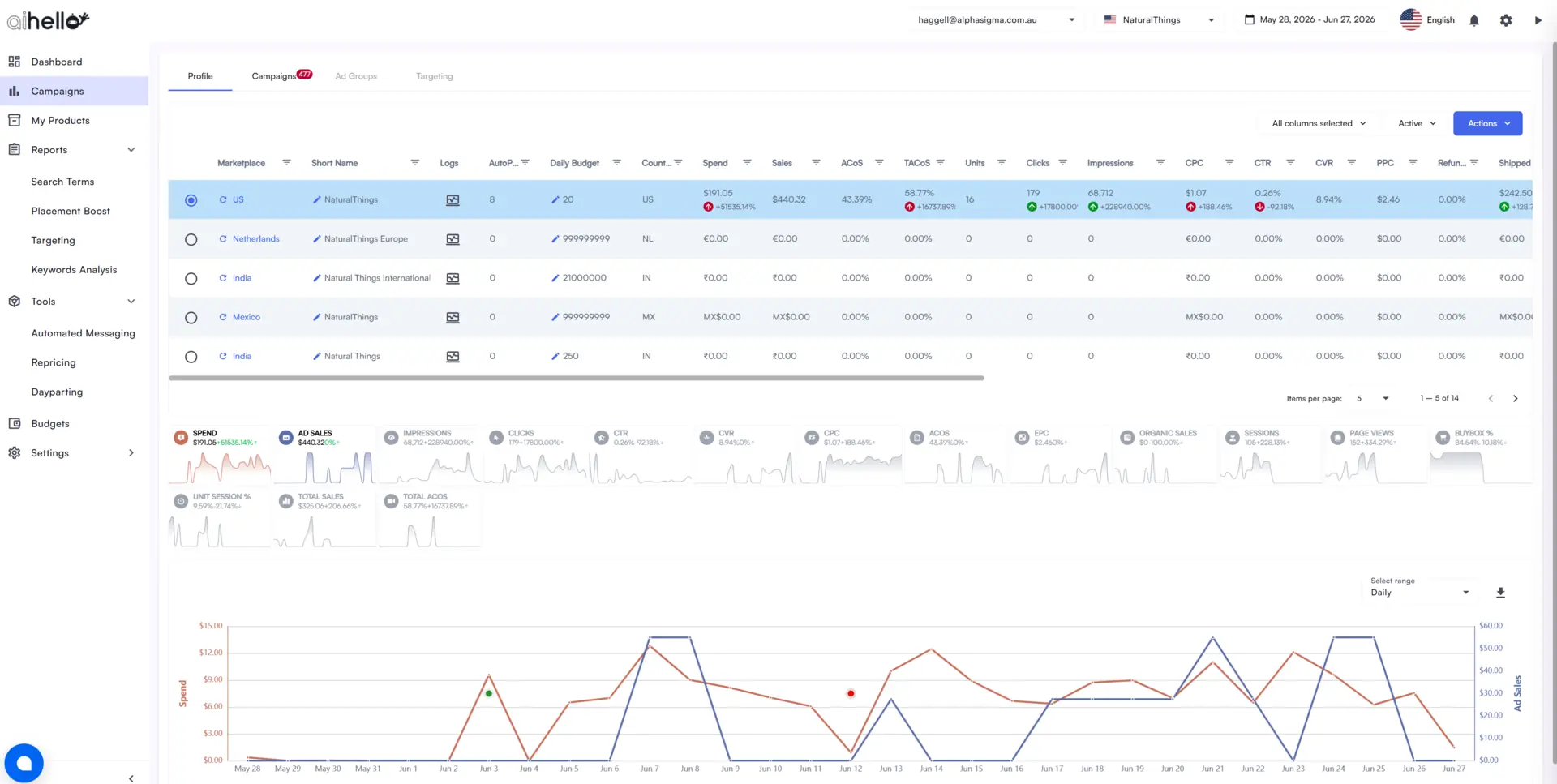
Bring your Amazon Ads account, keep the campaigns you already run, and let automation carry the day-to-day.
Automate the busywork
Stop babysitting bids and let AiHello run the day-to-day.
- Bids, budgets and search terms optimized 24/7
- Sponsored Products, Brands and Display all automated
- Inventory-aware rules pause low-stock ads
Keep the campaigns you built
Connect your existing account and pick up right where you are.
- Connects to your existing Amazon Ads account
- Works with the campaigns you already run
- Launch new structured campaigns in minutes
Automate it, or approve it
Decide what runs on autopilot and what waits for your sign-off.
- Approve every change, or let automation handle it
- Works across every marketplace you sell in
- One consistent workflow for brands and agencies
"AiHello helped me completely take my mind off PPC and grow my business 75% year over year. It is mind boggling."
Compare AiHello for your account
Tell us what you use today and what you want to improve.
Amazon PPC software alternatives FAQ
Start by matching the tool to your ad spend, the level of control you want, and whether you advertise only on Amazon or across other retailers like Walmart. Compare automation depth, keyword and search-term tooling, reporting, and how well the workflow fits your team's day-to-day process. It also helps to evaluate the learning curve and to confirm whether the pricing model fits your budget as your spend grows, since the right fit for a single-product seller differs from what a seven-figure brand or agency needs.
Commonly evaluated Amazon PPC tools include Perpetua, Teikametrics, Pacvue, Quartile, Helium 10 Adtomic, Scale Insights, Sellozo, Intentwise, and others such as AiHello. They differ mainly in automation approach (editable rule engines versus algorithmic or AI bidding), channel coverage (Amazon-only versus multi-retailer), and target customer size, so it is worth shortlisting two or three and comparing workflow fit. Because feature sets change often, confirm current capabilities directly with each vendor or through a trial before committing.
Pricing models generally fall into flat or tiered monthly fees, a percentage of your ad spend, and custom or enterprise quotes for larger accounts. A percentage-of-spend model can be lower cost at smaller budgets but rises as you scale, while a flat fee keeps costs predictable as ad spend grows. There is no single best model, so estimate your total cost at your current and projected ad spend, and confirm exact pricing and any minimums or contract terms with each vendor.
Free options, including Amazon's own campaign manager and spreadsheets, can be sufficient for new sellers, single-product accounts, or lower ad spend where manual management is still practical. Paid tools tend to add value as spend and complexity grow, offering automation, dayparting, portfolio-level budgeting, anomaly detection, and deeper reporting that save time. A reasonable approach is to weigh the subscription cost against the hours saved and the efficiency gains at your spend level, and to use a trial to test the fit before paying.
Rule-based automation uses if-this-then-that logic you set and can inspect, which gives transparency and tight control, while AI-driven tools analyze data to adjust bids and can be harder to inspect but may adapt faster at scale. Neither is inherently safer; reputable tools of both types let you set maximum bids and budget caps, and accounts with limited data can be more exposed to automated decisions made on noise. Whichever you choose, plan to monitor performance regularly rather than treating it as set-and-forget, and decide how much logic you want to be able to read and edit.
Before switching, confirm how your existing campaign structure, rules, and any historical data carry over, since some platforms retain more reporting history than others. Review onboarding effort, the learning curve, contract length or minimums, and whether the new tool's automation logic can recreate or improve the strategy you already run. Running a trial or onboarding a subset of campaigns first can reduce risk and let you compare workflow fit before fully migrating.
Switching PPC tools should not mean tearing your account apart. We built AiHello to connect to the campaigns you already run, take the repetitive bid, keyword, and budget work off your plate, and leave the strategy calls with you.
If you are weighing your options, we would happily walk through your own account with you and show exactly what automation would handle.
- The AiHello team
Compare AiHello on your account
See how AiHello fits your Amazon PPC workflow, or start with a free audit.