Amazon ads in 2025 are a battle. Skyrocketing CPC demands a new ‘Control Stack’ blending human strategy with automation for profitability. Master the future of retail media.
The Amazon Ads Operating Manual for 2025
Introduction: The 2025 Reality Check
2025 has turned Amazon advertising into a knife fight in a phone booth. Average cost-per-click (CPC) now hovers around $1.00 to $1.04, with category hotspots spiking as high as $3.00. That’s a 15–25% increase in just two years, driven by an explosion of new advertisers, rising competition from established retail brands, and Amazon’s continued expansion of ad formats across its retail media network, including Streaming TV, Sponsored Display, DSP, and more.
As retail media consolidates, Amazon is no longer a simple marketplace; it’s a media platform with product search attached. More brands, higher stakes, and CPC inflation mean one thing: chaos for anyone managing ads the old way.
Most brands are reacting, not optimising. They’re bleeding spend through fragmented campaign structures and wishful manual control. The fix isn’t “more tools”, it’s more control, the kind that blends human decision-making with precise, automated execution.
That’s where the control stack comes in.
This isn’t a theoretical think piece. It’s a field manual, a brutally practical guide to stay profitable in a high-CPC, data-driven advertising jungle.
Section 1: The Control Stack That Actually Works
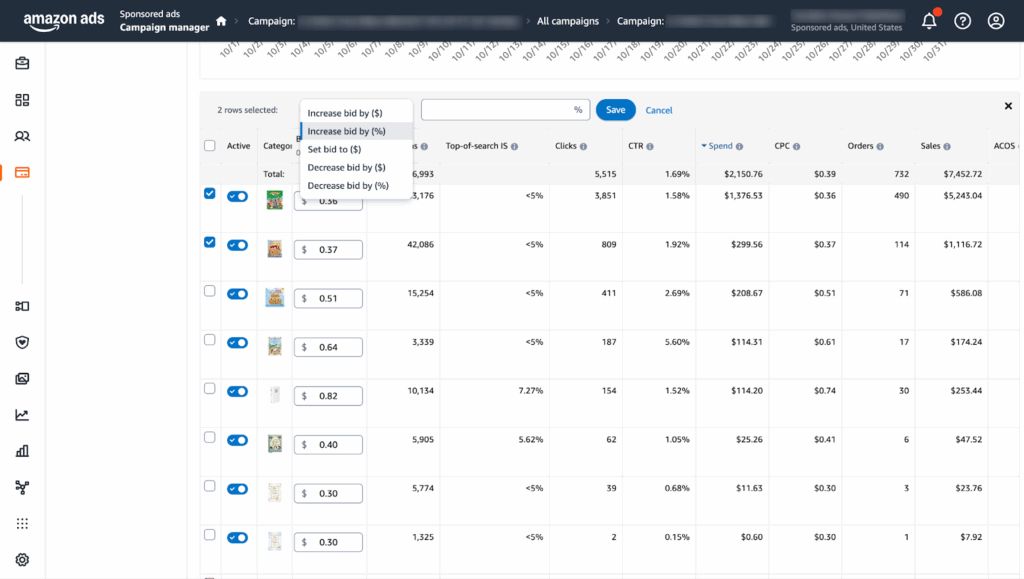
The modern Amazon ads ecosystem can be managed only through what we’ll call your Control Stack, five interlocking levers:
- Targeting: Who you show up for search terms, audiences, categories, and placements.
- Bids: How much you pay per click and where you place risk capital.
- Budgets: What caps your exposure day to day and campaign to campaign?
- Prices: The silent lever your listing price defines ad efficiency more than most admit.
- Inventory: The often-ignored constraint that amplifies or breaks every other lever.
An advertiser who masters all five wields complete command over spend and profit. The traditional manual stack built on spreadsheet uploads, delayed reactions, and gut-feel bidding simply can’t keep up with hourly volatility.
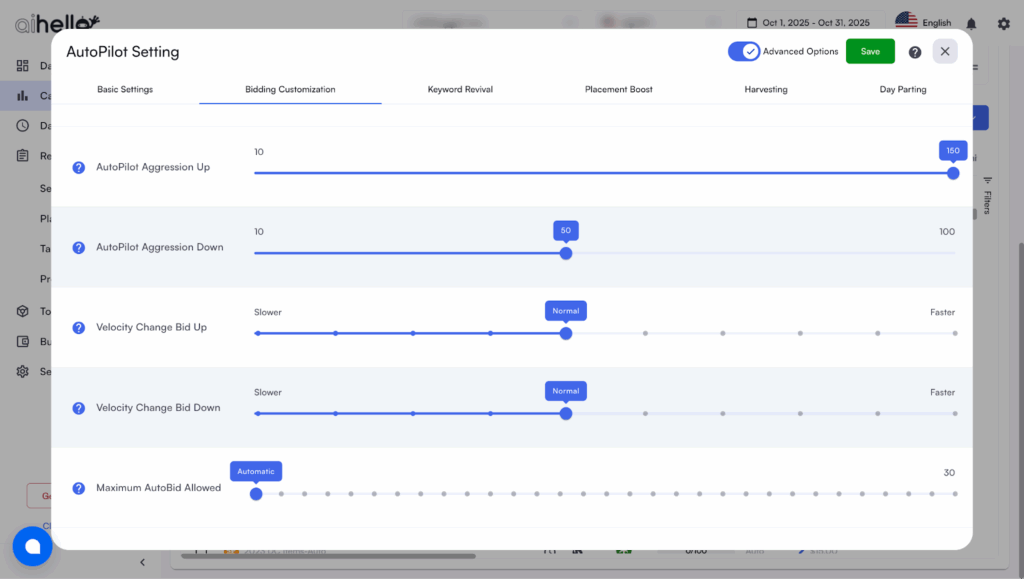
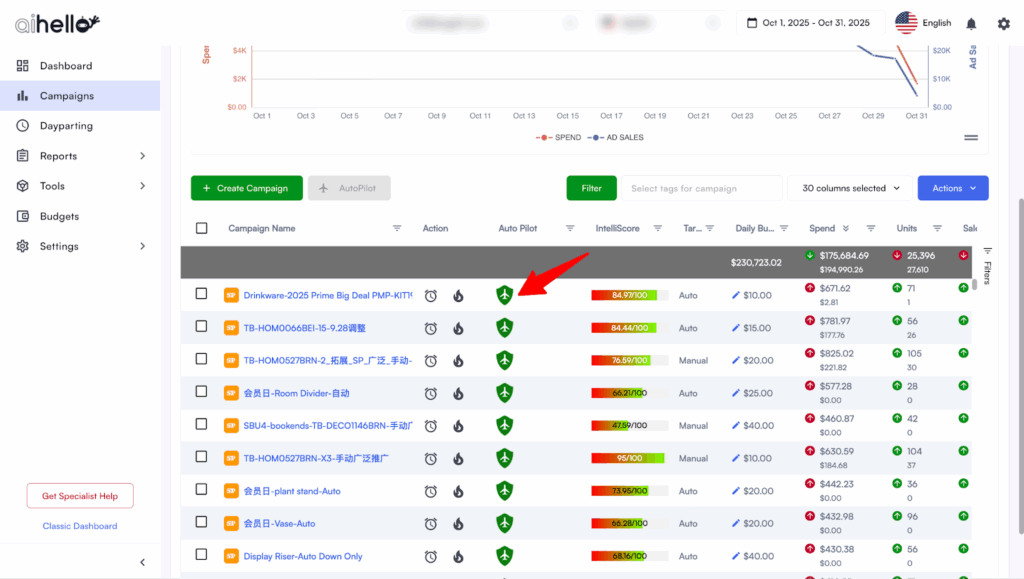
The AiHello-augmented stack integrates these levers through real-time data and adaptive logic. AiHello AutoPilot continuously monitors performance (impressions, CTR, conversion rate, CPC) and automatically aligns bids, dayparting, and budget pacing against actual demand trends.
Visualise the control loop this way:
| Process Step | Description |
| Input | Market signals (CTR, CPC trends, demand shifts, inventory) |
| Learning | AiHello’s algorithms identify profitable vs. wasted spend zones |
| Feedback | Human review through weekly dashboards |
| Adjustment | Automated bid and budget recalibration, updated hourly |
The key takeaway: Automation doesn’t replace you. It amplifies your precision and enforces discipline in places where humans tend to drift in timing, reaction speed, and scope.
Section 2: Target ACOS the Right Way (and When to Break It)
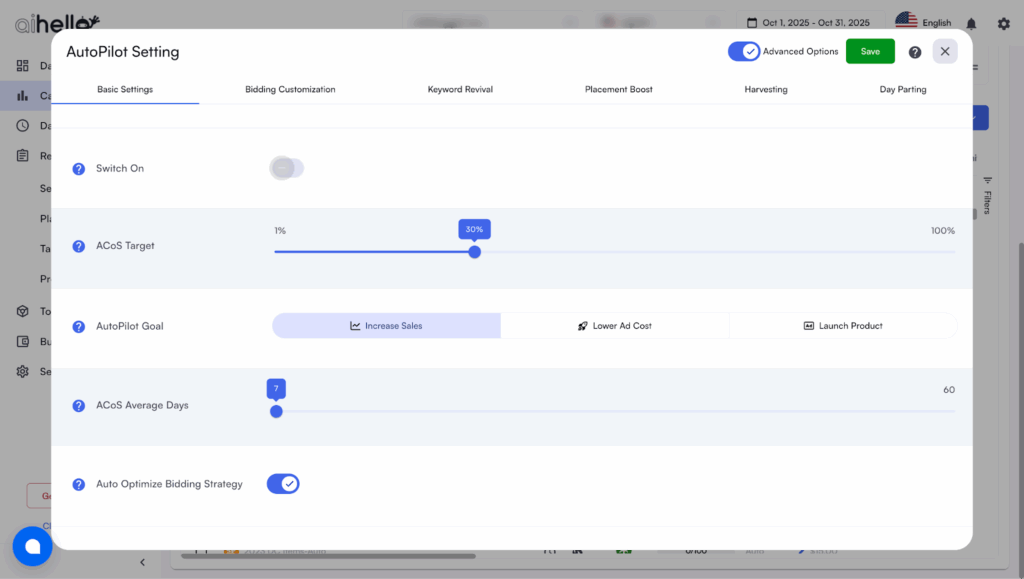
Most sellers pick a random ACOS target (say 25%) and anchor all decisions to it, then panic when reality disagrees. In 2025’s inflated CPC landscape, this rigid thinking gets expensive fast.
Let’s clarify the math:
ACOS=Ad SpendAd Sales×100%
But ACOS ignores the contribution margin, your true profitability after factoring in product cost, fees, and shipping. A profitable campaign might have an ACOS of 35% if its margins are 50%, while another at 20% could actually lose money if margins are thin.
The smarter frame: Set ACOS targets by SKU lifecycle, not by an arbitrary global number.
| SKU Type | ACOS Strategy | When to Break the Rule |
| New Launch | Aggressive ACOS (40–60%) to gain traction | Lower once the ranking stabilises |
| Proven Winner | Tight ACOS (15–25%) to maximise profit | Lift during seasonal spikes |
| Brand Defense | Flexible ACOS (20–35%) | Never starve branded keywords |
| Competitive Conquest | Opportunistic ACOS (30–45%) | Exit if CPC > LTV of new buyers |
AiHello aligns perfectly with this reality. AutoPilot optimises toward effective ROAS (profit-weighted) rather than rigid ACOS, automatically scaling bids up or down based on conversion strength, not vanity metrics. It breaks ACOS rules intelligently when margin compression or growth potential demand it.
The philosophy: chase profitability, not prettified percentages.
Section 3: AutoPilot Bid Tuning Continuous Optimisation Without Chaos
Every marketer dreams of the “optimal bid.” Spoiler: it doesn’t exist. Amazon’s auction landscape shifts by the hour, influenced by competitors, seasonality, and even lightning deals in unrelated categories.
Many automation tools react too hard, spiking bids 40% up or crashing them when the algorithm misreads a single day’s dip. The result: oscillating CPCs and unstable spending. AiHello’s AutoPilot is built to avoid these dumb swings.
Here’s how it does it:
- Micro-adjustments: Instead of sweeping changes, AutoPilot fine-tunes bids in small increments, monitoring performance elasticity.
- Stability logic: Bid changes are dampened using multi-day trend smoothing. One bad day won’t tank a performing keyword.
- Feedback loops: AutoPilot evaluates outcomes of its own decisions, constantly learning optimal ranges for conversion stability.
Imagine this as a stability curve of CPC vs. conversion rate. Your goal is the flat part of the curve where conversions peak before costs spiral. AiHello’s tuning rhythm holds bids within this sweet zone, automatically backing off when marginal CPC increases stop yielding incremental conversions.
You can still manually adjust logic thresholds, but 90% of bid tuning should happen invisibly, leaving you free to focus on pricing and creative.
The outcome: smoother spend, stronger ACOS control, and zero bid whiplash.
Section 4: Search-Term Harvesting That Won’t Pollute Your Account
Search-term harvesting is powerful but dangerous. Do it wrong, and you’ll bloat your campaigns with duplicate or irrelevant terms that kill data clarity.
The problem: Most sellers dump every converting term found in automatic campaigns straight into manual ones. The account becomes an unstructured mess, hard to interpret and impossible to optimise.
Smart harvesting is selective.
Here’s the disciplined process:
- Filter by conversion and frequency – harvest only terms with solid, repeat conversions.
- Apply a quarantine stage – move new search terms into a low-bid manual testing campaign first.
- Promote or pause – promote high performers to main campaigns; pause or negate poor ones.
- Maintain negative keyword hygiene – constantly block duplicates and irrelevant terms.
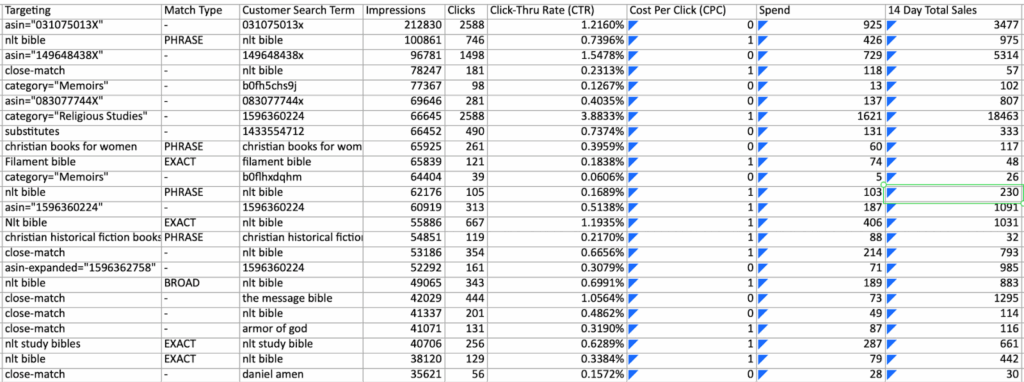
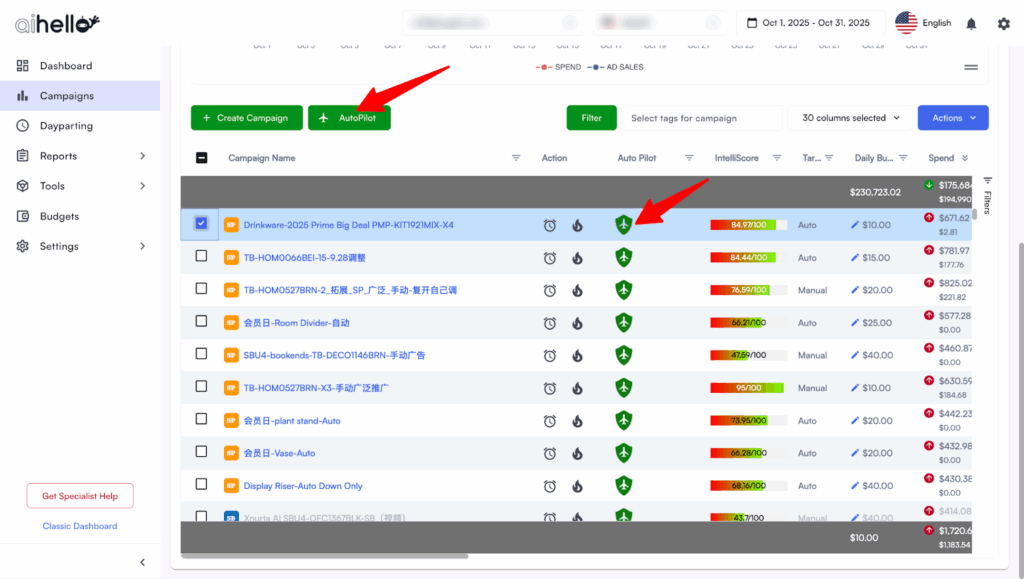
AiHello AutoPilot automates this cycle. It analyses Search Term Reports daily, extracts viable terms, tests them in isolation, and uses filters and safeguards to keep your structure lean.
Outcome:
- Fewer wasted clicks
- Faster data interpretation
- No keyword pollution
In short: Harvest strategically, not mechanically. A smaller, cleaner keyword list now outperforms keyword hoarding every single time.
Section 5: Manual Dayparting: How and When to Cut or Boost
Dayparting is the secret weapon for precision in Amazon advertising. It’s about serving the right ad, with the right budget, at the right time. By analysing hourly and daily performance data, brands can cut wasted spend and target peak buying windows with brutal efficiency.
The core logic: Not all hours (or days) perform equally. Conversion rates frequently spike during evenings and weekends, especially between 6 p.m. and midnight, while late-night and early-morning shoppers rarely convert and only drain your budget. So, why spend when nobody’s buying?
What data should you use?
- Impressions, clicks, and orders by hour and day from Amazon’s reports or your analytics software
- Heatmaps of conversion rates and ACOS trends across the week
- Seasonality overlays (shopping events, holidays, and payday effects)
Sample use cases:
- Throttling: Cut bids 30–50% from 2 a.m. to 6 a.m., especially if your product caters to business buyers.
- Boosting: Double bids on weekends and during evening rush, when conversion rates soar.
- Event-driven surges: Drastically increase ad budgets on shopping holidays or Prime Day, but only during proven high-conversion periods.
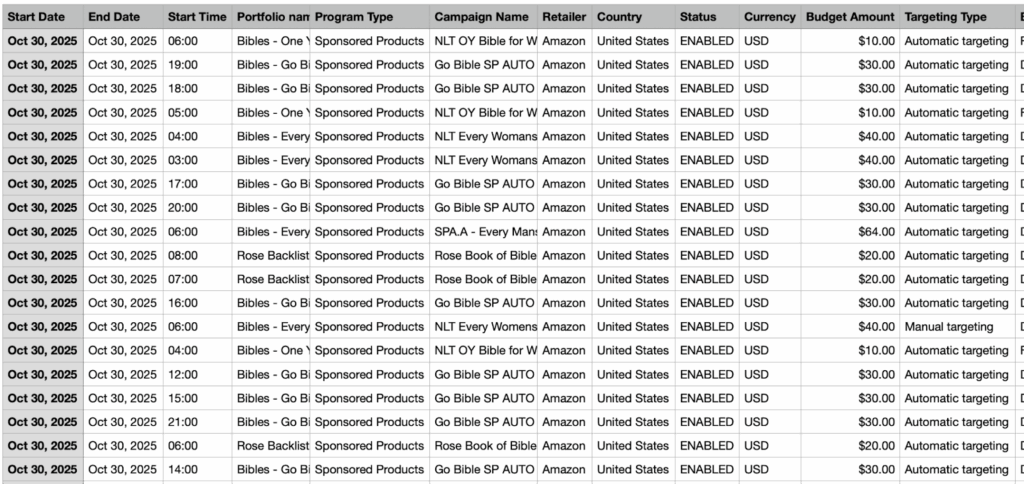
Executing with AiHello:
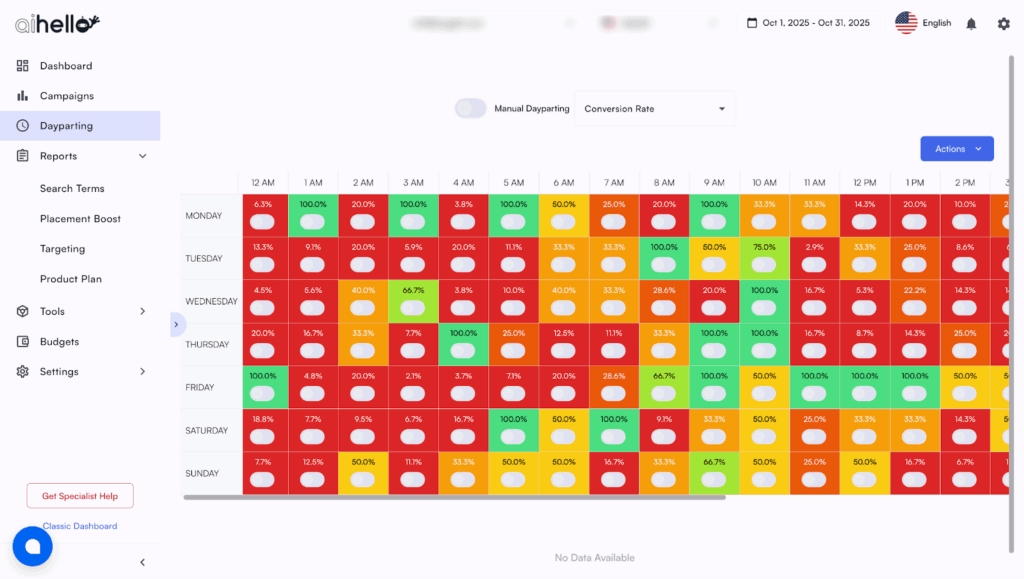
AiHello automates these cut/boost cycles via schedule-based budget rules. With a few clicks, you set campaigns to automatically ramp up spend when it matters (based on historic conversion heatmaps) and cut back in the troughs. No more logging in at weird hours, just relentless, data-driven timing.
Heatmap visualisation:
Picture a grid: hours of the day on the X, days on the Y. Green = high conversion, red = low. AiHello translates this map into automated campaign actions, so your highest bids always match your highest revenue windows.
Section 6: Budget Pacing That Follows Demand (Not Guesses)
Setting an ad budget and walking away is how you miss the compounding gains of demand-responsive advertising. Static budgets punish either momentum or profit; being too aggressive wastes money, and being too timid leaves market share on the table.
Why static budgets fail:
- They run out too soon during unexpected demand spikes.
- They choke performance during season peaks or promotion days.
- They leave unused spend sitting idle when you could be capturing more revenue.
Smart, adaptive pacing:
AiHello’s budget pacing algorithm reads the real signals: conversion velocity, CTR spikes, inventory swings, and marketplace trends. Budgets and bids dynamically shift up or down based on detected demand, not on arbitrary, outdated pacing tables.
How to align with seasonality and CPC trends:
- Use historical sales curves to spot Q4, payday, and event-driven surges.
- Sync pacing with real-time CPC movements raises budgets when CPCs drop, and conversions climb, and tightens when costs rise out of range.
- Review compounding effects: Just a 10% spend reallocation to high-performing hours, week over week, can add thousands in net new profit by quarter’s end.
Section 7: The Spend Hierarchy: Brand Defense vs. Competitor Offense
Strategic spending means knowing that not all ad dollars are worth the same. Your hierarchy:
- Defend: Secure your branded searches, don’t let competitors snipe your own customers.
- Protect: Lock down your own product pages from competitor ads.
- Expand: Conquest unbranded terms and competitor keywords.
Value-based allocation:
- Brand defence typically converts cheapest, but every extra dollar may add less incremental value the law of diminishing returns.
- Competitor conquests carry a higher risk but offer big share-shift upside.
- Smart model: Allocate 40% of spend to branded defence, 40% to high-value non-brand/generic, and 20% to pure competitor conquest. Dial the ratios to fit your margins and risk tolerance (start 50/35/15 for new brands; shift aggressively as you scale).
AiHello automation:
Set rules to prioritise defence when share drops below target, or to ramp up conquesting when a competitor’s products peak in visibility. The platform makes real-time decisions, always moving your dollars to the highest-impact zone.
Section 8: Measure What Matters: Profit, Not Vanity ROAS
ROAS makes for pretty dashboards, but can be dangerously misleading. A campaign with a fat ROAS might be cannibalising organic sales or propping up low-margin SKUs. The real metric: SKU-level profitability.
- Analyse profit per ASIN: Ad spend, gross sales, cost, shipping, and Amazon fees down to the SKU.
- Attribute spend to incremental sales, not simply total attributed revenue.
- Use AiHello to get granular reporting: See profit, ACOS, TACOS, and net margin at the SKU level so you can cut losing campaigns and double down on scalable winners.
Framework:
- Visibility: See what’s driving true profit.
- Correction: Move spend away from losers, amplify proven winners.
- Scaling: Reinforce only the campaigns and products that fuel sustainable growth.
Section 9: The Weekly Operating Cadence (45 Minutes to Stay in Control)
Consistency beats intensity. A killer Amazon ad operation is a disciplined weekly pulse, not a frantic scramble. Weekly must-checks (in order):
- Review top and bottom bids: Where did costs spike or drop unexpectedly?
- Identify wasted spend by search term and campaign.
- Analyse harvested terms, approve or negate with one click using AiHello’s automation.
- Check pacing: Are you running out of budget during peak hours, or leaving surpluses at day’s end?
- Assess ACOS drift by SKU and campaign. Act fast before trends burn cash.
Monday–Friday checklist:
- Monday: Review weekend data, adjust dayparting rules
- Tuesday: Deep dive on search query reports
- Wednesday: Audit budgets and pacing efficiency
- Thursday: Profitability snapshot by SKU
- Friday: Pre-weekend bid and budget tuning
With AiHello’s dashboards, this entire review is a disciplined 45-minute process, not an endless time sink. Set appointments, stick to the cadence, stay in control.
Conclusion: Take Back Control of Your Amazon Ads
In 2025, Amazon’s ad game is ruthless, fast, and relentless, but that’s exactly why a methodical, data-driven control stack separates winners from everyone else.AiHello AutoPilot is built to help you reclaim command, amplifying your best moves, automating the grunt work, and enforcing discipline where it matters most.
Ready to stop winging your ad strategy and start scaling intentionally?
Audit your control stack. Then turn on AutoPilot.