
Scaling Amazon PPC from $5K to $50K in monthly ad spend is not a spending problem. It’s a control problem. Most sellers don’t fail at this stage because demand disappears or ads suddenly stop working. They fail because the systems, habits, and decision-making frameworks that worked at low spend can’t handle higher volume.
At $5K a month, inefficiencies are easy to ignore. Small leaks don’t feel dangerous, delayed optimizations don’t seem urgent, and manual checks appear sufficient. But once spend moves into five figures, every weakness gets magnified. One bad hour can erase a full day’s profit. One unchecked keyword, placement, or bid spike can quietly burn thousands before anyone notices.
This is where many sellers panic and assume Amazon has become “too expensive,” when in reality their structure hasn’t evolved with their spend. Scaling safely isn’t about pushing budgets harder or chasing more traffic. It’s about building systems that maintain control as volume increases, so every additional dollar operates within clear boundaries.
This guide breaks down how successful sellers scale from $5K to $50K without letting ACOS spiral. We’ll cover how controlled budget pacing prevents chaos, why guardrails are essential at higher spend, how disciplined experimentation protects core performance, and where automation becomes critical for maintaining speed and consistency. The goal isn’t just to spend more, it’s to scale with confidence, predictability, and long-term profitability.
Why Scaling Breaks ACOS for Most Sellers
ACOS doesn’t spike because Amazon suddenly becomes expensive. It spikes because ad spend starts increasing faster than decision-making speed. Manual workflows that feel good enough at $5K a month simply can’t keep up once campaigns are spending thousands of dollars per day. The margin for delay disappears, and small inefficiencies become expensive very quickly.
As spending rises, several dynamics change at the same time. CPC volatility increases because you’re competing in more auctions, across more placements, and over more hours of the day. Even minor bid fluctuations can meaningfully impact daily spend. At the same time, waste compounds faster. A keyword or placement that’s slightly inefficient at low spend can drain significant budget when scaled, often before it’s flagged in a report.
Timing also becomes a critical factor. At higher budgets, waiting for end-of-day or weekly reviews is no longer enough. A few hours of unchecked spend during poor-performing periods can erase gains made earlier in the day. The problem isn’t that sellers aren’t optimizing, it’s that they’re reacting after the damage is already done.
This is why scaling successfully requires a structural shift. Instead of reacting to performance after ACOS spikes, sellers need systems that anticipate risk, enforce limits, and adjust in real time. When spend is controlled by structure rather than manual intervention, ACOS stops breaking under scale and becomes manageable again.
What Controlled Scaling Actually Looks Like
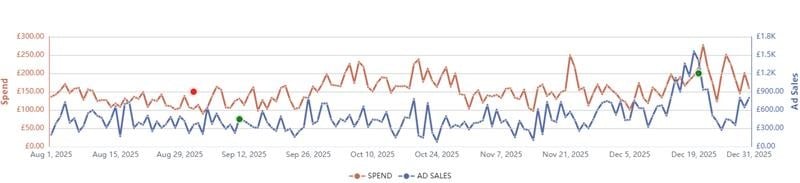
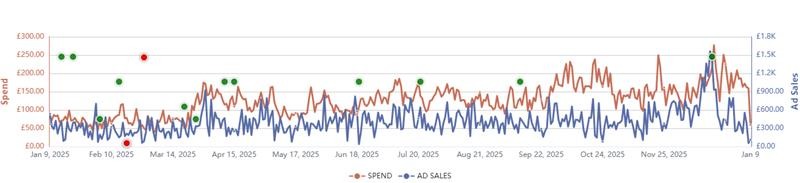
Ad spend increases gradually while ad sales scale in alignment, without chaotic spikes or collapses.
This is what healthy scaling looks like in practice. Spend rises over time, but it does so in a controlled rhythm, with ad sales tracking alongside it instead of lagging or collapsing. There are fluctuations, but no runaway spikes, no sudden drops, and no periods where spend disconnects from performance.
Budget Pacing: The Foundation of Controlled Scaling
The biggest mistake sellers make when increasing budgets is assuming daily caps are enough. In reality, daily budgets don’t control when money is spent, only how much can be spent in total.
Without pacing, Amazon can exhaust your budget early in the day during poor-converting hours, leaving you invisible during peak buying windows. At scale, this creates unstable ACOS patterns that look random but are actually structural.
Proper budget pacing distributes spend intentionally across the day. It ensures your campaigns remain active during high-conversion periods while preventing early-day overspend from low-quality traffic.
In controlled scaling environments, pacing protects you from:
- • Budget burn during low-intent hours
- • Missing late-day conversion spikes
- • Overreacting to short-term CPC fluctuations
This is one of the first areas where automation consistently outperforms manual control, simply because humans cannot monitor spend hour by hour.
Guardrails: Scaling Without Gamble
Scaling breaks the moment limits disappear. At low spend, weak controls feel harmless because the downside is small. At higher spend, the same gaps turn into real financial risk. A single aggressive keyword, placement, or hour can quietly consume a large portion of your budget before anyone reacts.
Guardrails exist to prevent that. They are not restrictions that slow growth; they are safety systems that make growth possible. At scale, guardrails define how far campaigns are allowed to drift before corrections happen. They ensure that no single element can hijack, spend or push ACOS beyond what your margins can support.
Effective guardrails operate across bids, budgets, and performance targets. Bid limits prevent CPC inflation during competitive spikes. Campaign-level ACOS targets keep optimization tied to real profitability rather than short-term volume. Spend caps and pacing controls protect budgets from being exhausted during low-intent hours. Placement ceilings prevent overpaying for visibility when conversion rates soften.
These controls don’t limit upside. They remove fear from scaling by containing downside risk. When sellers trust their guardrails, they scale more confidently because outcomes become predictable rather than chaotic.
Separating Core Spend From Experimental Budgets
One of the fastest ways to lose control of ACOS while scaling is mixing experimentation with core spend. At low budgets, this feels manageable. At higher budgets, it distorts performance signals and makes optimization reactive.
- Core spend exists to generate stable, predictable sales. These campaigns are built on proven keywords, ASIN targets, and placements that consistently convert within acceptable ACOS ranges. Their job is execution, not discovery.
- Experimental spend exists to explore uncertainty. New keywords, placements, and formats will naturally have uneven performance. That risk is acceptable only when it’s contained.
Separating the two keeps scaling clean. Core campaigns remain stable and optimized, while experiments run with limited budgets and clear evaluation windows. Failed tests don’t inflate overall ACOS, and successful tests can be promoted deliberately once they prove themselves.
This structure protects profitability while still allowing growth. Decisions are made using clean data instead of blended noise, which becomes increasingly important as spend rises.
Launch Cadence for New Targets
As budgets grow, sellers often expand too aggressively. Adding too many new keywords or targets at once floods campaigns with unproven traffic and destabilizes performance.
A disciplined launch cadence prevents this. New targets are introduced gradually, evaluated quickly, and either promoted or eliminated based on clear thresholds. Nothing runs indefinitely without justification.
At scale, the goal isn’t to test everything. It’s to test efficiently while protecting what already works. Controlled launches limit downside risk, improve signal quality, and keep ACOS trends stable.
Automation excels here by applying the same evaluation logic consistently. It doesn’t rush expansion or hesitate emotionally. It introduces new targets methodically, cuts losers early, and promotes winners based on data.
When launch cadence is controlled, scaling feels smooth instead of chaotic. Growth becomes deliberate, ACOS remains stable, and expansion stops feeling like guesswork.
Inventory Checks: The Hidden Scaling Risk
Nothing disrupts scaled campaigns faster than inventory blindness. Increasing bids and budgets while stock is tight creates a mismatch between demand and supply that advertising cannot fix. As availability drops, CPCs often rise due to unchanged competition, while conversion rates fall because shoppers hesitate when delivery windows stretch or stock appears limited.
The result is wasted spend and rising ACOS, even when targeting remains strong.
At higher spend levels, inventory awareness must be built directly into your scaling logic. Campaign aggression should never be static. It needs to adjust based on real inventory conditions, including available units, sell-through speed, and replenishment timelines. Scaling ads without this alignment doesn’t drive growth, it accelerates inefficiency.
Inventory-aware scaling protects performance by:
- • Reducing overbidding during low-stock periods when conversion rates naturally soften
- • Avoiding premium CPCs for traffic that cannot convert efficiently
- • Preventing forced stockouts caused by aggressive advertising
Beyond wasted spend, stockouts introduce longer-term damage. They interrupt sales velocity, weaken organic momentum, and create recovery costs that persist even after inventory is restored. What looks like a short-term scaling push often turns into a prolonged performance reset.
Scaling profitably means aligning demand generation with supply reality. When advertising intensity responds to inventory health, spend supports sustainable growth instead of creating short-lived spikes followed by avoidable setbacks.
AutoPilot Scaling Presets: Structured Growth, Not Guesswork
Manual scaling is cautious by nature because humans fear loss. When spend increases, every decision feels heavier, and hesitation often slows growth. Automation scales differently. It doesn’t react emotionally to short-term swings or isolated bad days. It responds to data patterns as they form, not after damage is done.
AutoPilot scaling presets are built to expand spend only when performance earns it. Instead of pushing budgets up in large, risky jumps, the system increases bids, budgets, and placement exposure in small, controlled increments. Each increase is continuously validated against ACOS, conversion rate, and spend efficiency, ensuring growth is supported by real performance rather than optimism.
This incremental approach matters at higher budgets. One-time budget jumps often hide inefficiencies, allowing waste to scale alongside winners. With AutoPilot, spending grows step by step. When performance strengthens, exposure increases. When conversion softens or costs rise, aggression automatically pulls back before losses compound.
Over time, this creates a healthy feedback loop. Strong keywords, ASIN targets, and placements are rewarded with more visibility. Weak or unstable elements are contained early, before they can distort overall performance. As a result, ACOS remains within a controlled range even as total spend increases, and scaling becomes a repeatable system rather than a reactive guessing game.
ActionPulse: Waste Control at Higher Spend
At $50K per month, waste compounds faster than revenue. A small inefficiency that costs a few hundred dollars at low spend can quietly turn into thousands when scale increases. By the time ACOS reflects the damage, the loss has already occurred.
ActionPulse-style monitoring shifts focus from lagging metrics to early warning signals. Instead of waiting for weekly reports or visible ACOS spikes, the system watches for changes in spend velocity, sudden CPC inflation, declining conversion signals, and abnormal budget acceleration. These indicators surface problems while they are still small and correctable.
Early intervention is what protects scaled accounts. Wasteful search terms are suppressed before they accumulate spend. CPC spikes are corrected before bids spiral. Campaigns that drift off-target are pulled back automatically instead of being discovered days later in an audit.
This proactive control reduces dependence on constant manual reviews and reactive cleanups. Spend stays aligned with real performance in near real time, which is why automated systems consistently outperform human review cycles at higher budgets. At scale, it’s not about fixing problems faster, it’s about preventing them from forming in the first place.
What Scaling Looks Like When It’s Working
When scaling is done correctly, performance stops feeling chaotic. ACOS no longer swings wildly from day to day, and spend doesn’t jump unpredictably based on fear or urgency. Instead, growth feels controlled and deliberate, with campaigns responding smoothly to demand rather than overreacting to short-term noise.
Spend increases gradually and consistently, supported by data rather than guesswork. As budgets grow, optimization becomes quieter instead of louder. You’re no longer jumping in to fix sudden spikes, patch overspend, or undo rushed decisions. The system handles most corrections before they escalate into problems.
Healthy scaling has a few clear characteristics. ACOS remains stable even as total spend rises, indicating that efficiency is being preserved alongside growth. Keyword and placement performance becomes cleaner as waste is filtered out earlier and winners receive more focused exposure. Daily spend patterns become predictable, making performance easier to forecast and manage.
Most importantly, emergency interventions become rare because issues are corrected before they spiral.
At this stage, advertising stops feeling like constant firefighting. PPC shifts into a true growth lever one that supports expansion without demanding daily stress, constant monitoring, or reactive decision-making.
Wrap up
If you’re planning to scale your ad spend beyond $5K and want to avoid the chaos that usually follows, structure matters more than aggression. AutoPilot helps sellers scale with pacing, guardrails, and continuous optimization built in.
Turn on AutoPilot to grow spend confidently without sacrificing control. And if you want a second opinion before scaling, speak with a strategist to map out a controlled growth plan tailored to your margins, inventory, and goals.
FAQs
What’s a smart daily budget increase?
Smart scaling increases daily budgets gradually, typically 10–20% at a time, while monitoring ACOS stability. Large jumps introduce volatility and hide inefficiencies.
Can I scale without automation?
Yes, but it requires constant monitoring and fast reaction times. Most sellers find automation essential beyond $10K–$15K/month to maintain control.
Should I scale all campaigns equally?
No. Scaling should prioritize campaigns and keywords that consistently meet ACOS and conversion benchmarks. Not all traffic deserves more budget.