
Agencies enforce rigid naming conventions to ensure campaigns, ad groups, and keywords are instantly identifiable, preventing overlap and enabling quick scaling.1
COMPANY CAMPAIGN STRUCTURE2
You can further divide them and place them under different ad groups. This way, you will be able to organize your data better and optimize your PPC accordingly.
WHOLESALE CAMPAIGN STRUCTURE
This is the highest level of campaign structure and needs to be extraordinarily optimized and fuss-free. Otherwise, it would be impossible to analyze your search term data to optimize your PPC campaign. Despite the enormous number of products involved, it would still be better for each one to be placed in a separate ad group. This will save a lot of time and effort that would otherwise go in pondering which products would go together.
However, Amazon allows a maximum of 20,000 ad groups per campaign. In this case, you would have to create multiple campaigns to fit in an astronomical-seeming number of products into ad groups.
This was all about different strategies for different types of Amazon sellers.
But, Am I doing it right?
ASIN Prioritization3
Last year, they hit $250k/mo at a 20% ACoS. Before AiHello, the brand was spending $25k per month on ads for various products. Some did well and others didn’t.
After they met us, they increased their spending to almost $50k a month but $46k of that went to a single ASIN.
This was because the product had the best reviews, the highest CVR, and a much higher search volume than many other ASINs combined.
It also spent 20% to 30% of the budget and generated 80% of total sales.
After our adjustments, the ASIN now does multiple 7 figures in ad sales and organic sales. That’s a lot more than what the total account used to do.
To use this Amazon PPC campaign strategy, start by sorting your ASINs in business reports based on sales volume and identifying the top products that collectively generate 80% of your revenue.
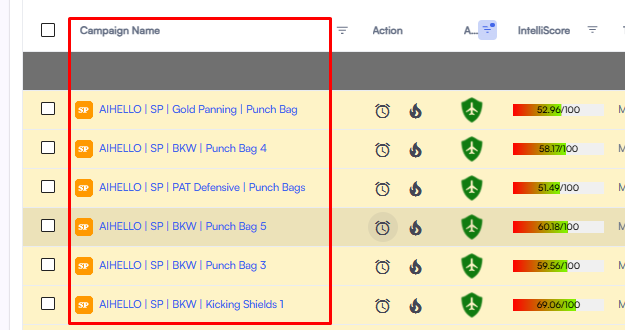
Structured Naming Conventions1
A typical format follows: [Product/ASIN] - [Campaign Type] - [Match Type] - [Goal], such as “Shampoo-B12345-Exact-Conversion”.
This hierarchical system groups campaigns by product line or objective, streamlining bulk edits and performance tracking across thousands of campaigns.
Clear naming eliminates wasted time hunting for specifics during audits and supports layered strategies, such as broad discovery feeding exact-match scalers. Agencies audit existing structures weekly, migrating keywords via waterfall methods where broad campaigns harvest data for precise targeting after 50+ clicks and 8%+ conversion rates.
AiHello replicates this natively through its Campaign Creator, which automatically generates structured campaigns by ASIN and goal when you enter products and budgets. Custom automations tailored by dedicated experts ensure naming aligns with agency standards, while SmartView dashboards visualise hierarchies without manual tagging. This out-of-the-box setup prevents self-competition from day one, just as top agencies do.
Stage 1: Bulk Optimization4
A large subset of Amazon Advertising Management Services clients was discovered to have done very little optimization in their Sponsored Products campaigns, while their Sponsored Brands, Sponsored Brands Video, and Sponsored Display campaigns remained essentially unchanged.
Bulk Edit enables you to apply Campaign Optimization methods to several campaigns and ad groups at the same time. It is only done if you have established campaigns that have been running for some time. You may choose from a variety of campaigns, apply criteria (or use pre-built filters), and then look for underperforming SKUs, keywords and targets, search phrases, and words.
You may make large-scale bid modifications at once, halt particular SKUs inside certain ad groups if they aren’t reacting well to advertisements, and even bulk-add negative exacts to campaigns and ad groups. Individual words that are your worst offenders can also be found and optimized.