

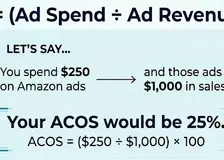
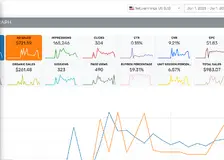

One unchecked keyword, placement, or bid spike can quietly burn thousands before anyone notices.1
Why Scaling Breaks ACOS for Most Sellers1
ACOS doesn’t spike because Amazon suddenly becomes expensive. It spikes because ad spend starts increasing faster than decision-making speed. Manual workflows that feel good enough at $5K a month simply can’t keep up once campaigns are spending thousands of dollars per day. The margin for delay disappears, and small inefficiencies become expensive very quickly.
As spending rises, several dynamics change at the same time. CPC volatility increases because you’re competing in more auctions, across more placements, and over more hours of the day. Even minor bid fluctuations can meaningfully impact daily spend. At the same time, waste compounds faster. A keyword or placement that’s slightly inefficient at low spend can drain significant budget when scaled, often before it’s flagged in a report.
Budget Pacing: The Foundation of Controlled Scaling
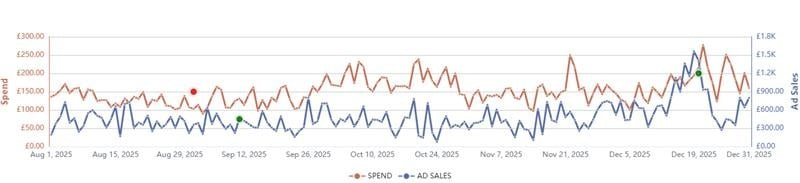
The biggest mistake sellers make when increasing budgets is assuming daily caps are enough. In reality, daily budgets don’t control when money is spent, only how much can be spent in total.
Without pacing, Amazon can exhaust your budget early in the day during poor-converting hours, leaving you invisible during peak buying windows. At scale, this creates unstable ACOS patterns that look random but are actually structural.
Proper budget pacing distributes spend intentionally across the day. It ensures your campaigns remain active during high-conversion periods while preventing early-day overspend from low-quality traffic.
In controlled scaling environments, pacing protects you from:
- • Budget burn during low-intent hours
- • Missing late-day conversion spikes
- • Overreacting to short-term CPC fluctuations
This is one of the first areas where automation consistently outperforms manual control, simply because humans cannot monitor spend hour by hour.
Guardrails: Scaling Without Gamble
Scaling breaks the moment limits disappear. At low spend, weak controls feel harmless because the downside is small. At higher spend, the same gaps turn into real financial risk.
Separating Core Spend From Experimental Budgets
One of the fastest ways to lose control of ACOS while scaling is mixing experimentation with core spend. At low budgets, this feels manageable. At higher budgets, it distorts performance signals and makes optimization reactive.
- Core spend exists to generate stable, predictable sales. These campaigns are built on proven keywords, ASIN targets, and placements that consistently convert within acceptable ACOS ranges. Their job is execution, not discovery.
- Experimental spend exists to explore uncertainty. New keywords, placements, and formats will naturally have uneven performance. That risk is acceptable only when it’s contained.
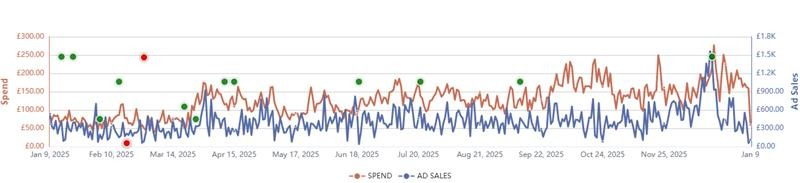
Separating the two keeps scaling clean. Core campaigns remain stable and optimized, while experiments run with limited budgets and clear evaluation windows. Failed tests don’t inflate overall ACOS, and successful tests can be promoted deliberately once they prove themselves.
This structure protects profitability while still allowing growth. Decisions are made using clean data instead of blended noise, which becomes increasingly important as spend rises.
Inventory Checks: The Hidden Scaling Risk
Nothing disrupts scaled campaigns faster than inventory blindness. Increasing bids and budgets while stock is tight creates a mismatch between demand and supply that advertising cannot fix. As availability drops, CPCs often rise due to unchanged competition, while conversion rates fall because shoppers hesitate when delivery windows stretch or stock appears limited.
The result is wasted spend and rising ACOS, even when targeting remains strong.
At higher spend levels, inventory awareness must be built directly into your scaling logic. Campaign aggression should never be static. It needs to adjust based on real inventory conditions, including available units, sell-through speed, and replenishment timelines. Scaling ads without this alignment doesn’t drive growth, it accelerates inefficiency.
Inventory-aware scaling protects performance by:
- • Reducing overbidding during low-stock periods when conversion rates naturally soften
- • Avoiding premium CPCs for traffic that cannot convert efficiently
- • Preventing forced stockouts caused by aggressive advertising