

AiHello
For starters, AiHello can automate your existing campaigns for better ACoS and create 100s of new campaigns in minutes. This saves you time and lets you optimize your performing campaigns, generating more ROI.1
It also offers specialist support and managed services to sellers so you can solve all your Amazon needs in one place.1
Because of their CTR history, old campaigns are still valuable.2
Perpetua in Short1
Perpetua offers complete PPC automation to sellers on Amazon, Instacart, Target, and Walmart.

While it helps you save time, the biggest issue is that the software takes down your old campaigns and sets up new ones even if the old ones were profitable.
You also have very little control over how your campaigns are managed. So you have to trust it blindly even when the campaign structure used does not generate the most ROI.
How are old campaigns still valuable ?2
According to Amazon’s definition of successful advertising, the winner of each auction in a bidding pool is determined by the click-through rate, which is the first variable considered by the A10 algorithm.
7-Step Activation Checklist3
- Connect Amazon Seller Central to sync all live campaigns
- Verify campaign types, portfolios, and ASIN mappings are imported correctly
- Set ACOS goals for each product or group
- Define minimum and maximum bid limits
- Set daily budgets for stable pacing
- Enable key modules: bid automation, keyword automation, placement optimization, dayparting
- Begin the four-week ramp-up and monitor weekly summaries
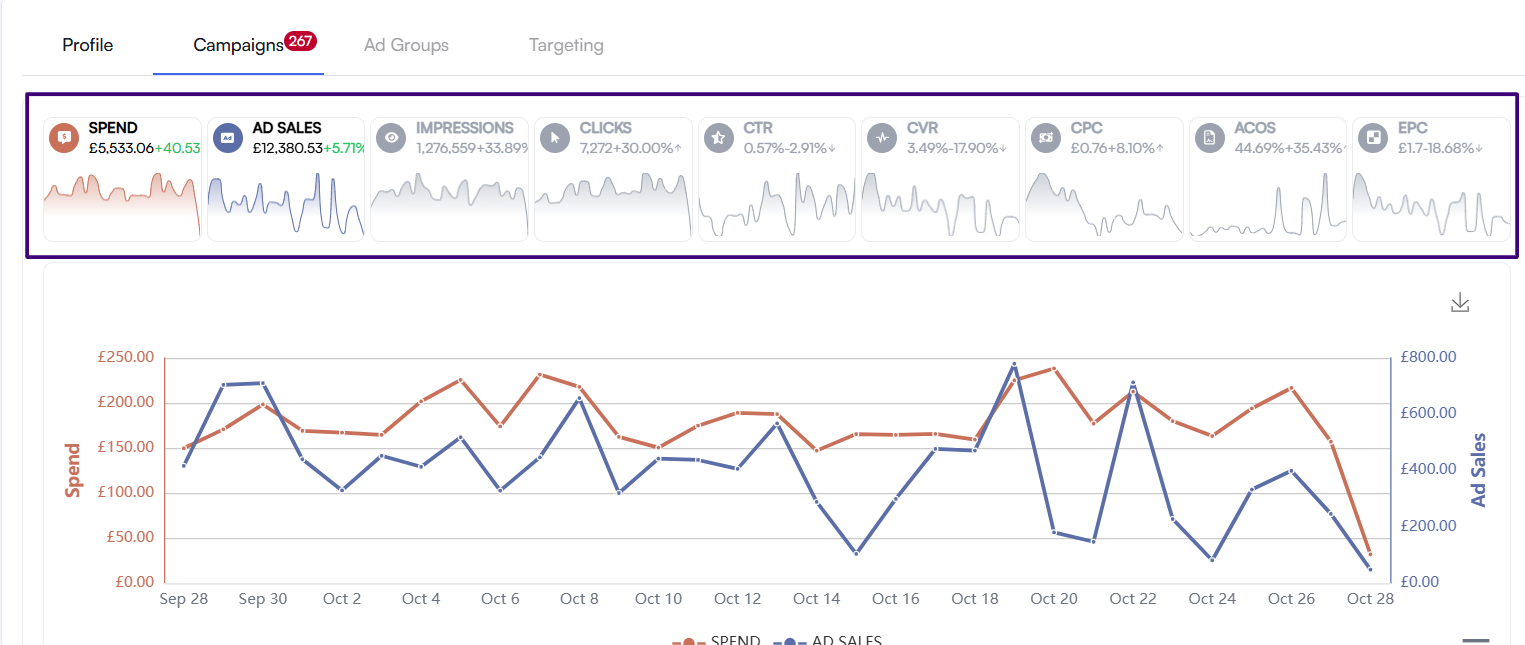
Once the initial setup is complete, AutoPilot begins analysing your campaigns and gradually increases the depth of automation based on performance patterns.
- Week 1: The system observes your campaign behaviour and identifies patterns of high-converting keywords, weak placements, and periods of overspending. Changes are light during this phase.
- Week 2: AutoPilot becomes more active. It begins adjusting bids more frequently, promoting converting search terms, and adding negatives to stop recurring waste.
- Week 3: Advanced controls, such as dayparting and placement optimization, kick in. Spend is distributed more efficiently throughout the day, and high-performing placements receive calculated boosts.
- Week 4: Performance stabilizes. Most unnecessary spend is cleaned up, keyword targeting becomes sharper, and ACOS trends begin to improve steadily.
By the end of the first month, you typically have campaigns that spend more efficiently, react faster to performance changes, and operate with far less manual intervention.
Reporting Cadences4
Agencies deliver tiered reports: daily alerts on anomalies, weekly performance deep dives (ACoS trends, top/bottom keywords), and monthly ROI summaries with forecasts. Dedicated managers hop on bi-weekly calls, using tools beyond Seller Central for intraday insights.
This cadence aligns with business cycles, flagging issues like out-of-budget winners early.
AiHello provides actionable reports out of the box: Daily bid logs explain changes, weekly/monthly summaries track ACoS/sales via SmartView, and bi-weekly expert reviews are included in Pro plans.
Risks & Safeguards3
That’s why every strong automation setup needs clearly defined guardrails. These prevent runaway behaviour and ensure the system stays aligned with your strategy rather than chasing noise.
Most sellers protect themselves using a few essential controls:
- Minimum and maximum bid limits These act as hard safety rails. They prevent your bids from dropping so low that you lose visibility or rising so high that costs explode.
- Daily spend caps Keeps your campaigns from burning through the budget during unexpected cost surges, especially during peak days or competitive spikes.
- Observation periods Automation waits for enough data before making major changes. This avoids reacting prematurely to a single bad day or a single high-cost click.
- Defined ACOS thresholds per product Each product behaves differently. Clear ACOS limits ensure the system knows when to stay aggressive and when to stay conservative.
With these in place, automation becomes steady, predictable, and far safer than manual trial-and-error.